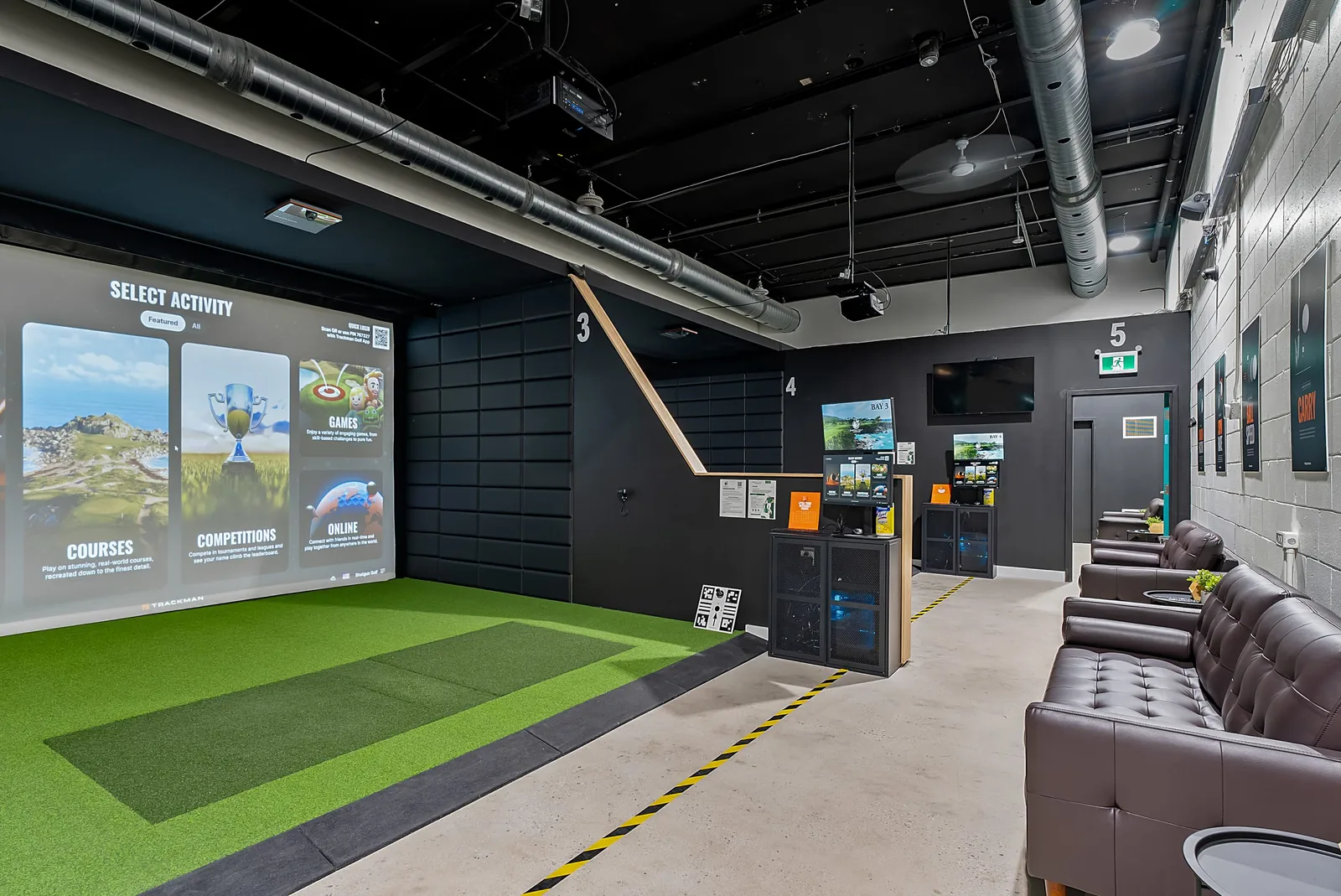
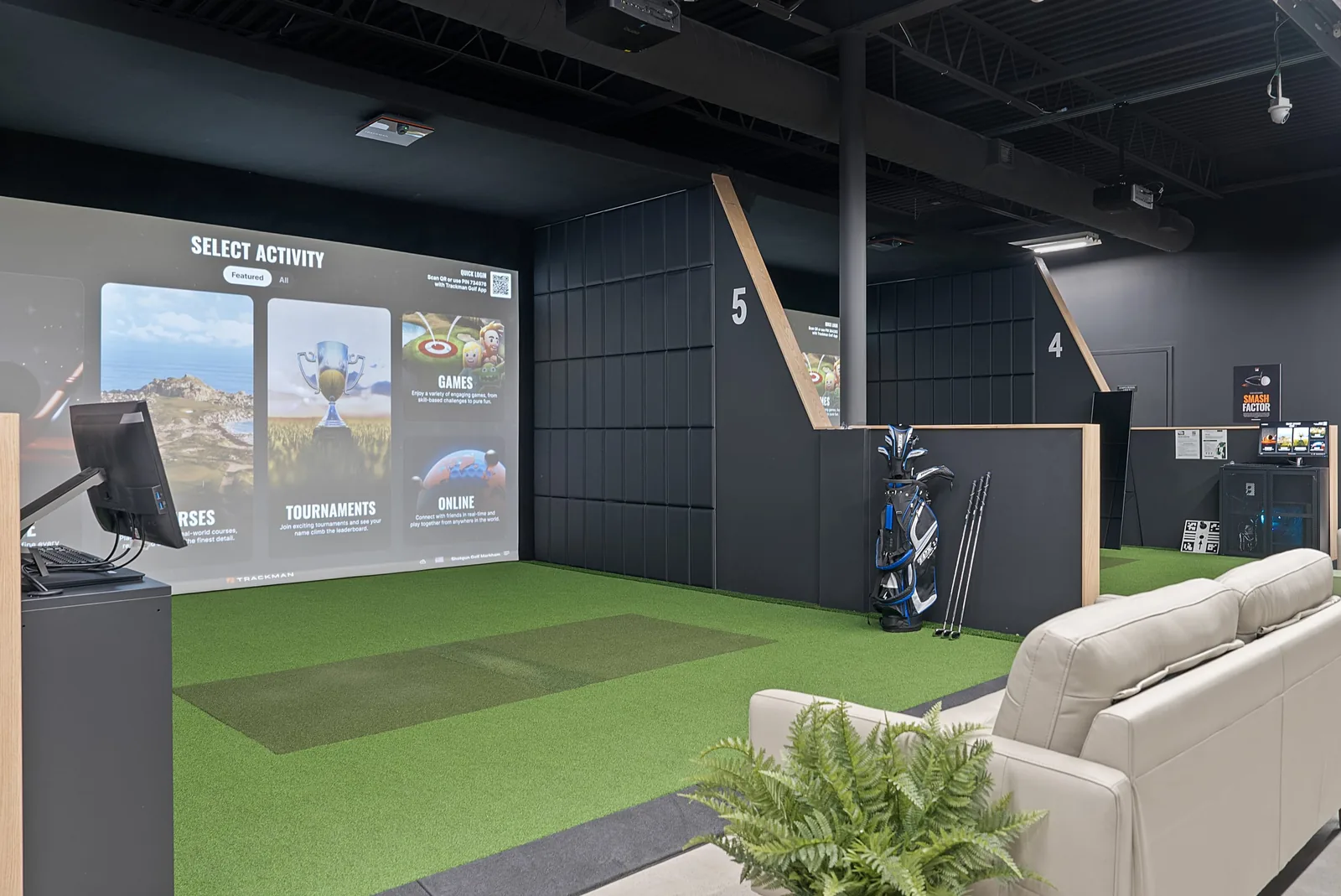
Most "simulator drills" you find online are range drills with a screen behind them. They work, but they waste the thing that makes a bay different: the machine tells you the truth after every shot.
These eight are built the other way round — each one uses a number you can only get indoors, and each has a pass mark so you know whether you did it.
1. The smash factor ladder
Use: smash factor
Why: it is the fastest read on strike quality there is.
Hit ten 7-irons. Ignore distance and direction entirely; the only thing that counts is smash factor. Note the number on each.
Now do it again at 80% effort. Most golfers find their smash factor goes up when they swing easier, because they find the middle more often. That discovery is worth more than a lesson to a lot of players.
Pass mark: eight of ten within 0.05 of your best number.
2. Start-line gate
Use: face angle
Why: the ball starts where the face points, so this isolates face control from everything else.
Pick a target and hit ten shots with a mid-iron, trying to start every one within two degrees of it. Do not care where it finishes — only where it started.
Pass mark: seven of ten inside two degrees.
This is the single most transferable drill on the list. Almost every golfer with a persistent slice or hook has a face problem they have been trying to fix with their swing path.
3. Nine windows
Use: launch angle and curve
Why: it builds control over face and path together.
Three heights, three shapes, nine combinations: low draw, low straight, low fade, up through high. Work through them with a 7-iron, one shot each, and note which ones you cannot produce at all.
The gaps are the interesting part. A golfer who cannot hit a low fade has a face-to-path relationship that only bends one way, which shows up on the course as a shot they cannot play.
Pass mark: any six of the nine on demand.
4. Carry ladder
Use: carry distance
Why: distance control is what actually scores, and almost nobody practises it.
Take one wedge and hit to 40, 60, 80 and 100 yards of carry — not total, carry. Three shots at each. You are learning what each swing length produces, which is the whole of wedge play.
Pass mark: all three inside five yards of the target number.
5. Spin check
Use: spin rate
Why: it tells you whether your strike is clean, low-tech and without a video camera.
Hit ten wedges and watch the spin. Big variation from shot to shot usually means contact is varying — a thin one spins less, a fat one spins less, a clean one spins consistently. Chasing a stable spin number is a more reliable path to good wedge play than chasing a high one.
Pass mark: eight of ten inside a 1,000 rpm band.
6. Driver efficiency, not distance
Use: smash factor and ball speed
Why: because everyone practises driver distance and almost nobody practises driver strike.
Hit ten drivers. Any that comes in below 1.45 smash factor does not count, regardless of how far it went. Keep going until you have ten that count.
Most golfers discover they need fifteen or eighteen swings to get ten good ones, which is exactly the hit rate that turns into two lost balls a round.
Pass mark: ten qualifying drives in twelve swings.
7. One-club course
Use: the course mode you are probably using anyway
Why: it forces shot-making instead of stock swings.
Play nine holes with a 7-iron and a putter. You will have to manufacture a low one, a high one, a short one and a full one, and you will discover which of those you cannot do.
Pass mark: finish under a score you set before you start.
8. The pressure putt
Use: the putting green in course mode
Why: indoor putting is imperfect, but the routine is not.
Ten putts from six feet. If you miss, start again from one. Most people never reach ten.
The value here is not the stroke — simulator putting will never be exactly your Saturday green. It is that you practise the feeling of a putt that matters, which is a thing you almost never get to rehearse.
How to run them
Pick two per session, not eight. Each one is worth fifteen minutes done properly and nothing at all done for three shots.
Write down the pass marks before you start, and write down what you got. Next session, beat it. That is the whole system, and it works better than any amount of swing theory.
The bays are open at every hour, and the quietest ones are cheapest — see rates and locations. If you want the numbers explained first, that is here, and the session structure to hang these on is here.